Every year, thousands of older adults receive a phone call that begins with “Grandpa (or Grandma), Please don’t tell Mom (or Dad) but I’m in trouble.” Within minutes, a stranger or an AI-generated voice, sounding just like a grandchild in trouble, has emotionally hijacked the conversation. By the time the call ends, a victim may have wired tens of thousands of dollars to a stranger. This is known as the Grandparent Scam, one of the most emotionally traumatic forms of elder fraud. And it’s growing. Understanding how this scam works and what you can do to stop it is the first line of defense for older adults and their families.
What Is the Grandparent Scam?
The grandparent scam is a form of impersonation fraud in which a scammer impersonates a grandchild, another family member, or a friend in urgent trouble – claiming they desperately need money. The “emergency” is usually dramatic, such as a car accident, an arrest, or being stranded in a foreign country. The scam caller relies on a combination of social engineering, emotional manipulation, and urgency to extract money before the victim has time to think through what is actually going on. In many cases, a second fraudster will then come to the phone or call the victim, posing as a police officer, lawyer, or bail bondsman to lend the story purported credibility.
Step 1: The Initial Call – Creating a Fake Emergency
The scam typically begins with an unexpected phone call. The caller may say something vague like “Grandma, it’s me!” The “emergency” is then introduced. For example, “I was in a car accident,” “I got arrested,” or “I’m in the hospital.” The story is always designed to create immediate fear and bypass rational thinking.
Step 2: The Demand for Secrecy

A critical hallmark of grandchild impersonation scams is the insistence on secrecy. The scammer, pretending to be a grandchild or loved one, will implore the victim not to tell the grandchild’s mother, father, or anyone else. This isolation tactic is deliberate. It keeps people who could intervene out of the equation. And many grandparents’ greatest wish is to be closer to their grandchild. Sharing a confidence does that, and the scammers know and rely on that.
e.g.: “Please don’t tell Mom and Dad, I’ll be in so much trouble…”
This demand for secrecy is often one of the clearest warning signs that something is amiss.
Step 3: The Money Request – Wire Transfers and Gift Card
Scammers typically request payment through methods that are nearly impossible to track and reverse: wire transfers, cryptocurrency, or prepaid gift cards. A “fixer,” who is actually another scammer, may arrive at the victim’s home to pick up the cash or cards in person, creating a false sense of urgency and legitimacy.
Gift card fraud is especially common because gift card codes are untraceable once shared. Victims are coached to go to a local pharmacy or grocery store, buy large-denomination gift cards, and read the numbers to the scammer over the phone.
Step 4: Repeat Contact and Additional Losses
Victims who pay once are often targeted again. Scammers may call back with a new emergency, like an additional fee for an attorney. The scammers often sell the victim’s information to other fraudsters. Once a person has been identified as a “good” target, they may face multiple waves of scams.
Who Is Targeted by the Grandparent Scam?
- Isolation: Older adults who live alone may have less frequent contact with family, making it harder to quickly verify an emergency.
- Cognitive changes: Even mild cognitive decline can make it more difficult to recognize social engineering tactics in real time.
- Unfamiliarity with caller ID spoofing: Technology enables fraudsters to display a grandchild’s phone number on the recipient’s caller ID display, making the call appear completely legitimate.
Warning Signs of Grandchild Impersonation Fraud
Knowing the red flags can make all the difference. Be wary if a caller:
🚩 Claims to be a grandchild or other family member in immediate danger or legal trouble.
🚩 Asks you to keep the situation secret from other family members.
🚩 Requests money via wire transfer, gift cards, or cryptocurrency.
🚩 Pressures you to act quickly, without time to verify.
🚩 Is actually a follow-up call from a purported “lawyer,” “officer,” or “bail bondsman.”
Any one of these alone is cause for caution. Multiple red flags are even more likely to be the sign of a scam.
How Do Scammers Get Someone's Information?
You might wonder, “How does the scammer even know a grandchild’s name?”
The answer, increasingly, is social media.
Scammers mine Facebook, Instagram, and other platforms for information about family relationships, names, travel plans, and life events.
A grandparent who proudly shares photos of a grandchild’s college trip abroad may inadvertently give criminals exactly the backstory they need to craft a convincing fake emergency.
Voice cloning technology is also emerging as a serious threat. AI voice generators can replicate a person’s voice from just a few seconds of audio – audio that might be gathered from a social media video or voicemail. This means that the generated “voice” of a grandchild on the phone is almost indistinguishable from the real thing.
How Can You Protect Yourself and Your Loved Ones?
Create a Family Password or Code Phrase
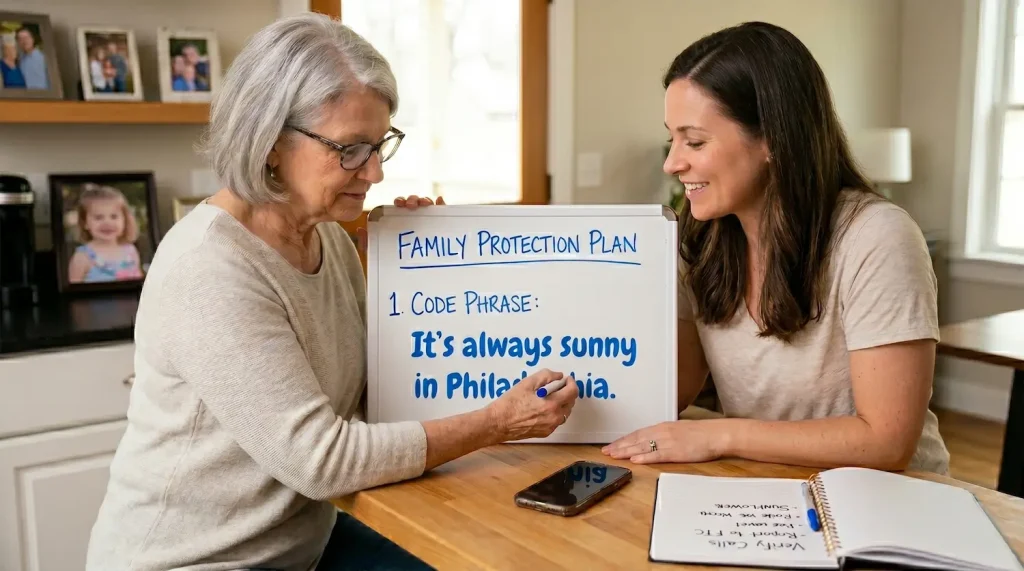
One effective defense against the grandchild impersonation scam is to establish a secret family password or code phrase. If anyone calls claiming to be a family member or friend in trouble, they must provide the password or code phrase, which will demonstrate that it is likely a legitimate call for help.
Verify Who Is Calling
Before you even consider sending money, hang up and call your grandchild directly. Do not call back the number provided by the scammer. Verification takes two minutes. If you can’t reach your grandchild, consider calling another family member or friend who is likely to know their whereabouts.
Educate Your Family About This Scam
Family conversations are one of the most powerful tools available to prevent fraud. Make sure loved ones know that this type of scam exists so that they recognize it if they receive such a call. The more familiar they are with the tactics of the grandparent scammer, the more equipped they will be to shut down the scheme.
Report It
If you or a loved one has received a call that appears to qualify as a grandparent scam, report it to:
- The Federal Trade Commission (FTC) at reportfraud.ftc.gov
- The FBI’s Internet Crime Complaint Center (IC3) at ic3.gov
- Your state Attorney General’s office
- AARP’s Scam Tracker at aarp.org/money/scams-fraud/tracking-map/
Reporting matters, as it helps authorities identify patterns, track criminal networks, and warn other potential victims.
What To Do If You’ve Been Victimized
If you or a loved one has sent money to a grandparent scammer, act quickly:
- Contact your bank immediately if a wire transfer was involved as the financial institution may be able to stop or reverse the transfer.
- Call local law enforcement to file a police report.
- If gift cards were used in the scam, call the card issuer — some companies have fraud departments that may be able to freeze unused balances.
- Ongoing financial monitoring is one of the most effective ways to guard against the large losses incurred in the grandparent scam and ensure that loved ones aren’t victimized a second time. With continuous monitoring of financial accounts, unusual transactions (e.g. unexpected wire transfers, large cash withdrawals, gift card purchases), can be identified and shut down early, preventing losses from escalating.
Love Is the Weapon Scammers Use Against Us
The grandparent scam works because it weaponizes the most human of instincts: the desire to protect someone we love. When we believe a grandchild is in danger, we don’t stop to consider all of the possible scenarios. We just act. That’s why awareness is a powerful tool in the fight against this type of fraud. Talk to your older relatives and friends. Share this post. Create that family password or code phrase today. And add a layer of financial technology to protect your life savings.

Liz Loewy, COO
Liz Loewy is the co-founder and Chief Operating Officer at EverSafe. A graduate of the University of Pennsylvania and Albany Law School, Liz was previously a prosecutor in the Manhattan District Attorney’s Office, where she oversaw the Office’s Domestic Violence Unit before founding its first Elder Abuse Unit – serving as its Chief for 18 years. Liz presented at the last White House Conference on Aging and has served as an expert witness as well as trial counsel on a number of criminal and civil cases involving financial fraud, including the successful prosecution involving the late Brooke Astor, who was exploited by her only son and his attorney. She has presented on the subject of elder financial abuse at conferences in the US and Europe and authored a number of publications, including a book entitled “Financial Exploitation of the Elderly: Legal Issues, Prevention, Prosecution, Social Service Advocacy” (Civic Research Institute).
