
According to Merriam Webster, the classic definition of a ‘scam’ is: a fraudulent scheme, confidence trick, or deceptive act designed to cheat someone out of money, property, or sensitive personal information through falsehoods and broken trust.
There are so many scams these days that most of us feel a certain fatigue just at the mention of the word. But that fatigue is what scammers count on.
The number of sophisticated frauds keeps climbing. This means that it’s more important than ever to stay alert, not just for ourselves, but for our loved ones who may be more vulnerable to these schemes.
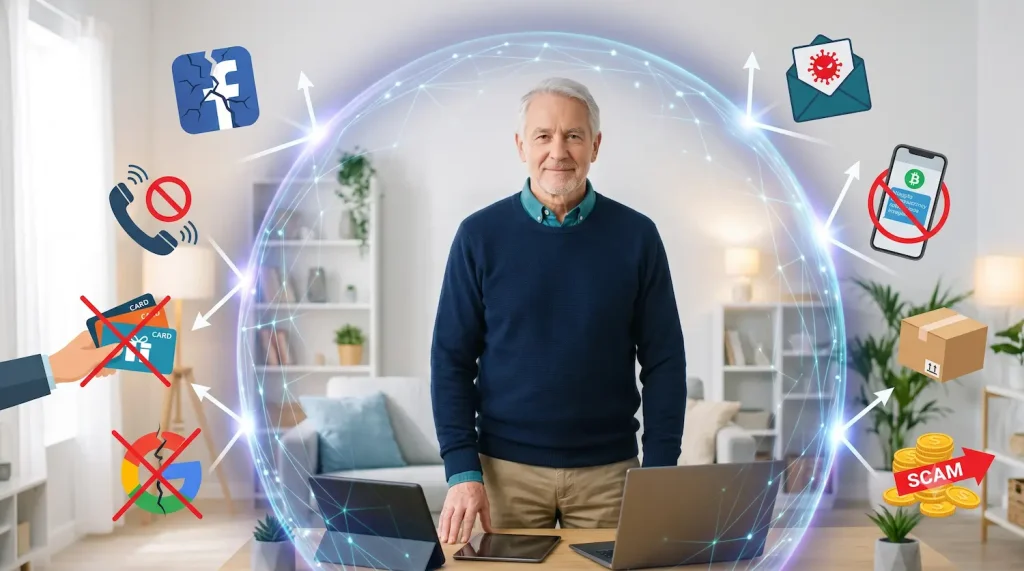
Below are eight of the most common scams targeting older adults today, how each one actually works, and what you can do to avoid becoming a victim.
1. Facebook Account Takeover Scam
This scam starts when a hacker seizes control of someone’s Facebook profile, and then poses as that person to post emotionally loaded sales pitches to the victim’s friends list. Perhaps a car, a hot tub, or an entire estate are ‘being liquidated’ purportedly because a parent has moved into assisted living or a relative has died.
Friends who trust the familiar name may send deposits, perhaps via Zelle or Venmo, for items they’ve never seen. Victims in Georgia, New Jersey, Colorado, and New York have collectively lost thousands of dollars this way.
What makes an account takeover especially hard to resolve is that hackers are often able to activate two-factor authentication using their own phone number, so the rightful owner can’t receive the code necessary to reset the password. Facebook can then take weeks to restore access to the real account owner.
Learn how these takeovers unfold and how to lock your account down with a strong passphrase, 2FA, or a passkey in our full guide to the Facebook account takeover scam.
2. The Grandparent Scam
While the Facebook scam takes place online, the Grandparent Scam begins offline – usually with a phone call. This classic scam has been going on for years.
A scammer calls an older family member and opens with a line like, “Grandma, it’s me, please don’t tell Mom.” The caller then spins a story about a car accident, an arrest, or a hospital stay. These are designed to trigger fear before there’s time to think through whether the call is real. And every grandparent’s greatest wish is to have that relationship with their grandchild in which secrets can be shared.
A second fraudster may then take the phone, posing as a lawyer, police officer, or bail bondsman to make the story sound more credible, and request money by wire transfer, cryptocurrency, or gift card numbers read aloud over the phone. All of these are nearly impossible to trace or reverse.
Several details make this con especially convincing. Criminals have mined social media for grandchildren’s names and travel plans. Occasionally, the scammer spoofs the caller ID to display a family member’s real phone number. Some even clone a grandchild’s voice from just a few seconds of audio pulled from a video.
Learn more about the red flags and how to defend against them in our full article about the Grandparent Scam.

3. Gift Card Scams
Scams involving gift cards are often part of another phone scam like the Grandparent Scam, referenced above, since a gift card number is a payment method a scammer asks for once they’ve got someone on the hook.
An unsuspecting older adult receives a call about a problem that needs urgent resolution: a grandchild in jail, unpaid taxes, a suspended Social Security number, a pending power shutoff for non-payment.
Whatever the story, the ‘fix’ is similar. Go to a local store or supermarket and buy Apple, Google Play, or Visa gift cards. Then, read the numbers on the back of the card over the phone. If those numbers are read aloud, it’s like handing over cash.
It’s worth repeating: no government, utility, or legitimate company employee will ever ask for a payment this way.
4. The Google Account Takeover Scam
Gmail has approximately 130 million subscribers in the United States alone, which makes it a prime target for bad actors, much like the Facebook accounts discussed earlier. Rather than directly breaching Google’s servers, criminals use malware to steal Gmail credentials from infected devices. Those usernames and passwords are then bundled into large databases and traded on underground forums.
Because a Gmail account is rarely used only for email, whoever holds it can lock out the real owner, read years of private messages, open saved documents, and retrieve credit card numbers and passwords directly from Google’s built-in password manager. They can also email everyone on the contact list of the real owner, turning a single stolen password into a fraud campaign targeting the people who trust that email address.
Learn how to shut this down with two-step verification, ranked from hardware security keys and passkeys down to text codes, in our full guide to Google and Gmail data breaches.
5. Invitation Scams
This scam is also a classic favorite of scammers. An email arrives that appears to be an invitation to a special occasion. The design is polished. A friend’s name is prominent. The ‘friend’ may have been a previous victim.
If the recipient clicks on ‘View and RSVP,’ a login page appears asking for a Gmail, Outlook, Yahoo, or AOL username and password.
Handing over credentials may give a scammer access to the recipient’s email account if the account isn’t adequately protected.
Scammers imitate Evite, Paperless Post, and Punchbowl because this trick works differently than the others. There are no threats or scare tactics. There is only the allure of being included (or not being left out) of a party, wedding, or other celebration. FOMO (Fear of Missing Out) is very persuasive.
It bears repeating: no genuine invitation service requires you to enter a password to display a card. Learn the red flags and what to do if someone already clicked a link in our guide to invitation scams.
6. Cryptocurrency Text Scam
Coinbase is a publicly traded cryptocurrency exchange in which individuals buy, sell, and store digital currencies like Bitcoin and Ethereum. Like Gmail and Facebook, its size makes it a magnet for impersonation scams.There are thousands of different cryptocurrencies (digital coins and tokens) and dozens of alternative exchange platforms.
The Coinbase text scam works like this: a message is sent to a phone announcing a pending withdrawal or an unusual login attempt, complete with a realistic-looking verification code, a case number, and a support line to call “if it wasn’t you.”
That phone number routes to a fraudulent call center, where an agent who already knows the caller’s name and address from earlier data breaches walks them through ‘securing’ their funds by moving them to a new vault or wallet address controlled by the scammer.
Coinbase never calls or texts to hand out a new wallet address or seed phrase, and no legitimate two-factor message ever includes a phone number to call. The safest response is always to open the official app directly and verify any activity from there.
7. Brushing Scams
Not every scam opens with a demand for money or passwords. Some begin with something as harmless-looking as an unexpected delivery from the USPS or another delivery service.
A package arrives that nobody in the household ordered. Inside is a cheap item such as a trinket, a phone case, or seeds. The shipper is usually an international third-party seller who found the recipient’s name and address online. Posing as that person, a supposedly verified buyer, the seller publishes fake positive reviews under their identity to inflate a product’s ratings and sales figures.
Because the merchandise costs little to buy and ship, the scheme pays for itself. Federal law allows recipients to keep unsolicited goods without paying, but the arrival itself could be a warning that personal details are already circulating. Passwords should be changed, and credit reports watched closely.
A newer twist adds ‘quishing’: a card with a QR code that serves as the way to discover who sent the gift. Scanning it opens a convincing counterfeit site designed to collect personal or financial information.
If an aging parent lives alone, mention this scam before a mystery delivery ever shows up. Let them know that a free package they never ordered is probably not a gift, and that any QR code inside should remain unscanned. Ask them to call you whenever something unexpected arrives, since a quick conversation is the easiest defense.
8. Investment Fraud
According to the FBI, investment fraud now accounts for nearly 49% of all scam-related losses.
The deception usually starts with a wrong-number text, a friendly message in a Facebook group about retirement income, or a new online connection who seems to have plenty of time to talk. Investment fraud often begins on social media platforms where people are looking for companionship or love. Weeks of ordinary conversation follow. Only later does a trading platform come up, mentioned casually, the way a friend might share good news.
The platform’s website looks professional. A small first deposit appears to grow. Even a small withdrawal goes through, a moment that removes trepidation. Bigger deposits follow, sometimes pulled from retirement savings or a home equity line.
When the money is finally requested back, a ‘release fee’ applies – to pay taxes, for legal clearance, or for account activation. In the end, the platform was never real, and the growing balance on the screen was nothing more than a fabricated number in a database.
Staying One Step Ahead of Scammers
Every one of these scams relies on the same basic formula: create urgency, gain someone’s trust, and then ask the victim to participate in activity that they can’t reverse, such as a wire transfer, the conveyance of a gift card code, their password or a crypto deposit. Once you or a loved one recognizes that these communications sound familiar, it becomes much easier to pause and question the message or call before acting on it, no matter how convincing it feels in the moment.
The best defense is a combination of healthy skepticism and a few concrete habits: verify unexpected requests through a separate, known, official channel; never give out passwords, verification codes, or gift card numbers over the phone; and enable strong two-factor authentication – ideally a passkey or hardware key – on email and social media accounts. If you have older loved ones, it’s worth walking through these scams with them directly, since a 10-minute conversation today can prevent a devastating loss later. And make sure that you help them keep an eye on their finances by receiving alerts for suspicious activity along with them.
If you or someone you care about has encountered any of these scams, explore our full guides linked above for detailed red flags and recovery steps. Learn more about EverSafe protection.

Liz Loewy, COO
Liz Loewy is the co-founder and Chief Operating Officer at EverSafe. A graduate of the University of Pennsylvania and Albany Law School, Liz was previously a prosecutor in the Manhattan District Attorney’s Office, where she oversaw the Office’s Domestic Violence Unit before founding its first Elder Abuse Unit – serving as its Chief for 18 years. Liz presented at the last White House Conference on Aging and has served as an expert witness as well as trial counsel on a number of criminal and civil cases involving financial fraud, including the successful prosecution involving the late Brooke Astor, who was exploited by her only son and his attorney. She has presented on the subject of elder financial abuse at conferences in the US and Europe and authored a number of publications, including a book entitled “Financial Exploitation of the Elderly: Legal Issues, Prevention, Prosecution, Social Service Advocacy” (Civic Research Institute).
